Accompanies Lecture 13. Goal: estimate the relative energy acceptance \(\Delta E/E\) of a CALA-like permanent-magnet doublet for \(\sim 20\,\mathrm{MeV}\) protons. Use the interactive quadrupole doublet simulator (Fig. 13.2) to place the magnets for \(E_0\) and to visualise off-energy rays.
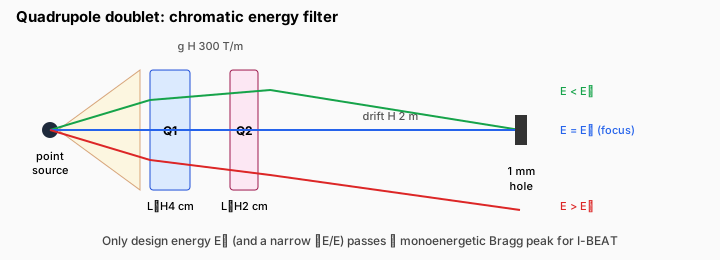
Setup (use these numbers unless you argue for better ones)
- Point-like proton source with approximately isotropic emission into the forward hemisphere (or a wide cone).
- Broad kinetic-energy spectrum (TNSA-like); design / tune energy \(E_0 = 20\,\mathrm{MeV}\).
- Permanent-magnet quadrupole doublet with gradient \(g \approx 300\,\mathrm{T/m}\).
- Effective magnetic lengths \(\ell_1 \approx 4\,\mathrm{cm}\) (first quad), \(\ell_2 \approx 2\,\mathrm{cm}\) (second, opposite polarity).
- Image / platform distance of order \(z_{\mathrm{img}} \approx 2\,\mathrm{m}\) from the source (or from the doublet exit — state your convention).
- Circular aperture of diameter \(1\,\mathrm{mm}\) at the image plane.
Tasks
- Compute the magnetic rigidity \(B\rho = p/q\) and the focusing strength \(k=g/(B\rho)\) for \(20\,\mathrm{MeV}\) protons. In the thin-lens approximation, estimate the focal lengths of each quadrupole.
- Assemble a transfer-matrix model of the doublet + drift (thick lenses are welcome if you prefer). Tune / place the elements so that \(E_0\) is imaged onto the \(1\,\mathrm{mm}\) hole for a reasonable source–doublet distance. State all distances you assume.
- Energy acceptance. Vary the kinetic energy around \(E_0\) (chromatic \(k(E)\)) and find the band \(\Delta E\) for which particles emitted at small angles still land inside the \(1\,\mathrm{mm}\) aperture. Quote \(\Delta E/E\) at \(20\,\mathrm{MeV}\). (A Monte-Carlo ray trace of an isotropic, polyenergetic source is ideal; a few characteristic rays are enough for a first estimate.)
- Briefly discuss: how does \(\Delta E/E\) change if the hole is larger, or if \(E_0\) is lowered to \(10\,\mathrm{MeV}\) at the same \(g\)?
Proton momentum: \(p=\sqrt{2mE}\) non-relativistically to a few percent at \(20\,\mathrm{MeV}\) (\(\gamma-1\approx 0.02\)); using the relativistic \(p\) is cleaner. \(B\rho\,[\mathrm{T\,m}] \approx 0.144\sqrt{E\,[\mathrm{MeV}](1+E/(2\times 938))}\) for protons is a handy check.