- After Exercise 4, the plane-wave solution (Gibbon) explains why a free electron gains large oscillatory energy but no net acceleration in a symmetric field.
- Finite-duration and focused Gaussian pulses break strict plane-wave symmetry: longitudinal fields and intensity gradients enable net drift and the ponderomotive force \(\mathbf{F}_p = -\nabla U_p\).
- A plasma refracts light with \(\eta = \sqrt{1 - \omega_p^2/\omega^2}\); the distinction underdense (\(n_e<n_c\)) vs overdense (\(n_e>n_c\)) sets whether the laser propagates (electron acceleration) or interacts at the surface (ion acceleration).
- In reality \(\eta(\mathbf{r},t)\) is not fixed: density and effective electron response feed back on the fields — the full dynamics is not analytically closed.
- Paul trap (mechanical analogue) — shaking membrane / wavy surface (or water waves): particles are pushed out of high-amplitude regions toward calm water.
- Paul trap (real) — electrodynamic trap with lycopodium (Bärlapp) spores: the same ponderomotive expulsion in a laboratory RF quadrupole field.
In Exercise 4 you integrated the relativistic Lorentz equation numerically for an electron in a Gaussian laser pulse. Today we connect those trajectories to the analytic plane-wave structure (Gibbon), then move to realistic focused pulses, the ponderomotive force, and a first look at how a plasma refracts the laser — the bridge to laser–plasma acceleration schemes in the rest of the course.
1. Analytic solution: electron in a plane-wave pulse
The starting point is the Lorentz force equation, \[ \frac{d\mathbf{p}}{dt} = q\left(\mathbf{E} + \mathbf{v}\times\mathbf{B}\right), \] with \(\mathbf{p} = \gamma m \mathbf{v}\) and \(q=-e\) for an electron. The energy equation is \[ m c^2 \frac{d\gamma}{dt} = q\,\mathbf{v}\cdot\mathbf{E} = -e\,\mathbf{v}\cdot\mathbf{E}. \]
In a linearly polarized plane wave, propagating along the \(x\)-direction with vector potential \(\mathbf{A}(\xi)\) that depends only on the phase \(\xi = \omega_0 t - k_0 x\), the equations can be solved analytically (Gibbon, Short Pulse Laser Interactions with Matter, Ch. 2). Two invariants of the motion are:
- \(\mathbf{p}_\perp - q\mathbf{A}_\perp/c = \text{const}\) (transverse canonical momentum),
- \(\gamma - p_x/(m c) = \text{const}\) (light-front invariant for a plane wave).
For an electron initially at rest before the pulse arrives, these reduce to \(\mathbf{p}_\perp = q\mathbf{A}_\perp/c\) and \(\gamma = 1 + p_x/(mc)\). The normalized vector potential \(a = eA/(m_e c)\) directly sets the quiver momentum: transverse momentum scales as \(a\), and the instantaneous kinetic energy scales as \(a^2\) in the weakly relativistic limit. Compare your Exercise 4 plots with these relations — the figure-of-eight trajectory in a finite pulse is the time-dependent generalization of the monochromatic solution.
Crucially, if the pulse is a perfect plane wave and the electron starts and ends in vacuum, the invariants guarantee no net energy or momentum gain after the pulse has passed — only large transient oscillatory energy while the field is present.
2. Temporally Gaussian laser pulse (still a plane wave)
To move from a monochromatic plane wave to a realistic laser pulse, we first keep the spatial dependence as a plane wave but introduce a finite temporal envelope. A convenient model is a Gaussian pulse in time: \[ \mathbf{E}(t,x) = \hat{\mathbf{y}}\, E_0\, \exp\!\left[-\frac{(t - x/c)^2}{\tau^2}\right] \cos\!\left(\omega_0 (t - x/c) + \varphi_{\text{CEP}}\right), \] where \(E_0\) is the peak amplitude, \(\tau\) is related to the pulse duration, \(\omega_0\) is the carrier frequency, \(\varphi_{\text{CEP}}\) is the carrier–envelope phase, and \(\hat{\mathbf{y}}\) is the polarization direction.
The corresponding magnetic field is \[ \mathbf{B}(t,x) = \hat{\mathbf{z}}\, \frac{E_0}{c}\, \exp\!\left[-\frac{(t - x/c)^2}{\tau^2}\right] \cos\!\left(\omega_0 (t - x/c) + \varphi_{\text{CEP}}\right), \] so that \(|\mathbf{B}| = |\mathbf{E}|/c\) and \(\mathbf{B} \perp \mathbf{E} \perp \mathbf{k}\).
This model captures the large transient momenta and energies while the pulse is present. However, as long as the field remains a perfect plane wave with an envelope that depends only on \((t - x/c)\), the plane-wave invariants still guarantee that an electron which starts and ends outside the pulse cannot gain net energy or net momentum.
3. Spatial focus: Gaussian beam and longitudinal fields
Real laser pulses are not only finite in time but also spatially focused. A standard model is the Gaussian beam in the paraxial approximation. For a beam propagating along \(x\), linearly polarized in \(y\)-direction, the complex field of a continuous wave can be written as \[ E_y(r,x,t) = \Re\Bigg\{ E_0\, \frac{w_0}{w(x)} \exp\!\left[-\frac{r^2}{w^2(x)}\right] \exp\!\left[-i\big( \omega_0 t - k_0 x - \frac{k_0 r^2}{2R(x)} + \zeta(x) \big)\right] \Bigg\}, \] with \(r^2 = y^2 + z^2\), beam waist \(w_0\), radius \(w(x) = w_0 \sqrt{1 + (x/x_R)^2}\), Rayleigh length \(x_R = \pi w_0^2/\lambda_0\), wavefront radius \(R(x)\), and Gouy phase \(\zeta(x)\).
A temporally Gaussian focused pulse multiplies this spatial envelope with \(\exp[-(t-x/c)^2/\tau^2]\). Important: a focused beam is not obtained by simply “multiplying a plane wave with a Gaussian in space”. Maxwell’s equations require that spatial variation of the transverse components induces longitudinal fields \(E_x\) and \(B_x\) of order \(1/(k_0 w_0)\), ensuring \(\nabla\cdot\mathbf{E}=0\) and \(\nabla\times\mathbf{E}=-\partial_t\mathbf{B}\) consistently.
These longitudinal fields contribute to net drift and to the effective ponderomotive force that pushes particles out of high-intensity regions — the mechanism that breaks the plane-wave symmetry.
4. Ponderomotive force in an inhomogeneous oscillating field
When the field amplitude varies in space, cycle-averaging the Lorentz force produces a slow secular drift. In the non-relativistic limit for a particle with charge \(q = Z e\) and mass \(m = R m_e\), with \(\mathbf{E}(\mathbf{r},t) = \hat{\mathbf{e}}\, E_0(\mathbf{r})\cos(\omega_0 t)\) and slowly varying \(E_0(\mathbf{r})\), perturbation theory gives
\[ \langle \mathbf{F}_p \rangle = -\,\frac{Z^2 e^2}{4 m \omega_0^2}\, \nabla E_0^2(\mathbf{r}) = -\nabla U_p, \] with ponderomotive potential (linear polarization) \[ U_p = \frac{Z^2 e^2 E_0^2}{4 m \omega_0^2} \propto \frac{Z^2}{m}\, I_0 \lambda_0^2. \] The force always points toward lower intensity — out of the laser focus. For circular polarization the same structure holds with a factor of 2 in \(U_p\).
Derivation outline (non-relativistic perturbation theory)
Split motion into fast oscillation \(\mathbf{x}_1(t)\) at \(\omega_0\) and slow drift \(\mathbf{v}_2\). To first order, \(\mathbf{v}_1 = (Ze/m\omega_0)\,\hat{\mathbf{e}}\,E_0(\mathbf{r}_0)\sin(\omega_0 t)\). Expand \(E_0(\mathbf{r})\) around the guiding center, include the magnetic term from \(\nabla\times\mathbf{E}\), and cycle-average the second-order force. All terms oscillating at \(\omega_0\) vanish; the secular part is proportional to \(E_0\nabla E_0\). A full step-by-step derivation is Exercise 5, Part B.
5. Plasma refractive index — and why it is not constant
Once ionization creates free electrons, the plasma responds collectively. In the cold, collisionless limit the dielectric function of an electron fluid is \[ \varepsilon(\omega) = 1 - \frac{\omega_p^2}{\omega^2}, \qquad \omega_p = \sqrt{\frac{n_e e^2}{\varepsilon_0 m_e}}, \] and the refractive index is \(\eta(\omega) = \sqrt{\varepsilon(\omega)}\). The critical density is defined by \(\omega_p = \omega\): \[ n_c = \frac{\varepsilon_0 m_e \omega^2}{e^2}. \] For Ti:sapphire (\(\lambda_0 \approx 800\,\mathrm{nm}\)), \(n_c \approx 1.7\times 10^{21}\,\mathrm{cm}^{-3}\).
Underdense (\(n_e < n_c\)): \(\omega_p < \omega\) → the laser
propagates in the plasma (group velocity \(v_g < c\)). This is the typical
regime for electron acceleration in underdense gas targets
(laser wakefields, etc.).
Overdense (\(n_e > n_c\)): \(\omega_p > \omega\) → the laser
cannot propagate into the bulk; the field is evanescent with skin depth
\(\delta \sim c/\omega_p\). Interaction is confined to the surface — the typical
starting point for ion acceleration from solid or liquid targets
(TNSA, radiation pressure, …).
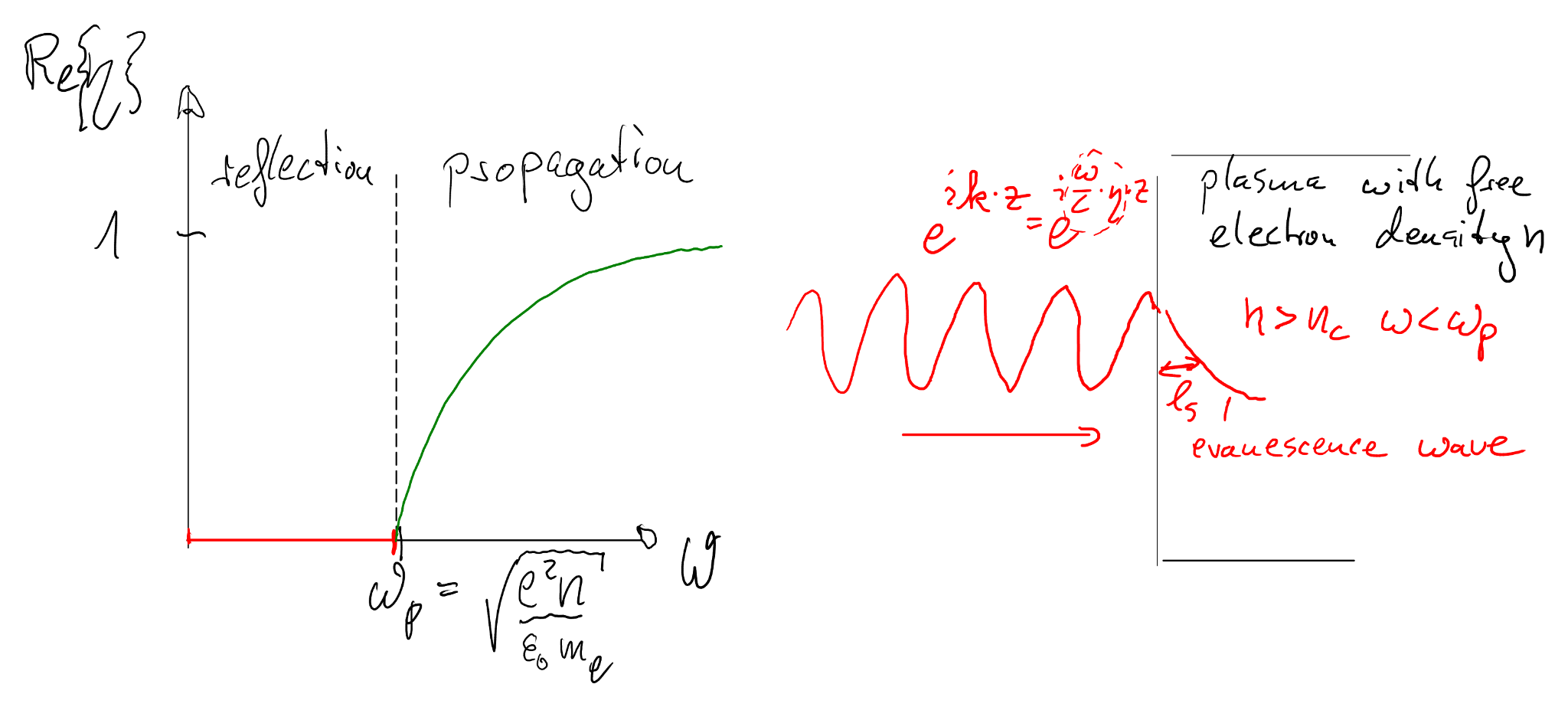
This clean picture assumes uniform \(n_e\) and fixed \(m_e\). In a real experiment neither is true:
- Ionization increases \(n_e(\mathbf{r},t)\) during the pulse rise (and prepulse), changing \(\eta\) locally.
- Plasma expansion lowers the density on the time scale of the pulse, pushing an initially overdense target toward transparency.
- Ponderomotive and thermal motion modify the effective electron response (\(m_e \to \gamma m_e\) in simple models), so both \(n_e\) and the inertia of the electron fluid depend on the local laser intensity.
The refractive index is therefore a feedback quantity: \(\eta(\mathbf{r},t)\) depends on \(n_e(\mathbf{r},t)\) and on how electrons move in the field, while the field itself is determined by Maxwell’s equations in the medium defined by \(\eta\). The fully coupled problem (Maxwell + particle motion + ionization) cannot be treated analytically in general. Useful limits exist — uniform cold plasma, fixed \(n_e\), normal incidence, slowly varying envelope — and we will use them throughout the course. Relativistic corrections to \(\eta\), self-focusing, and absorption mechanisms are developed in Lecture 6 and beyond.
6. Outlook
Lecture 6 develops how \(\eta(\mathbf{r},t)\) changes (ionization, ponderomotive expulsion, relativistic transparency) and introduces the PIC method used for the rest of the course. Absorption mechanisms follow in Lecture 7.
Work through Exercise 5 (transparency estimate, ponderomotive-force derivation, and collisional reflectivity) before the tutorial.