- A free electron in a symmetric plane wave performs quiver motion but gains no net cycle-averaged absorption.
- Collisions introduce a phase lag between field and velocity → inverse Bremsstrahlung (detailed Drude model in Exercise 5).
- At solid targets, the dominant channels are often collisionless interface mechanisms: resonance absorption, Brunel (vacuum) heating, and relativistic \(j\times B\) heating.
- Absorbed energy creates hot electrons that set up sheath fields at the target boundaries — the bridge to ion acceleration.
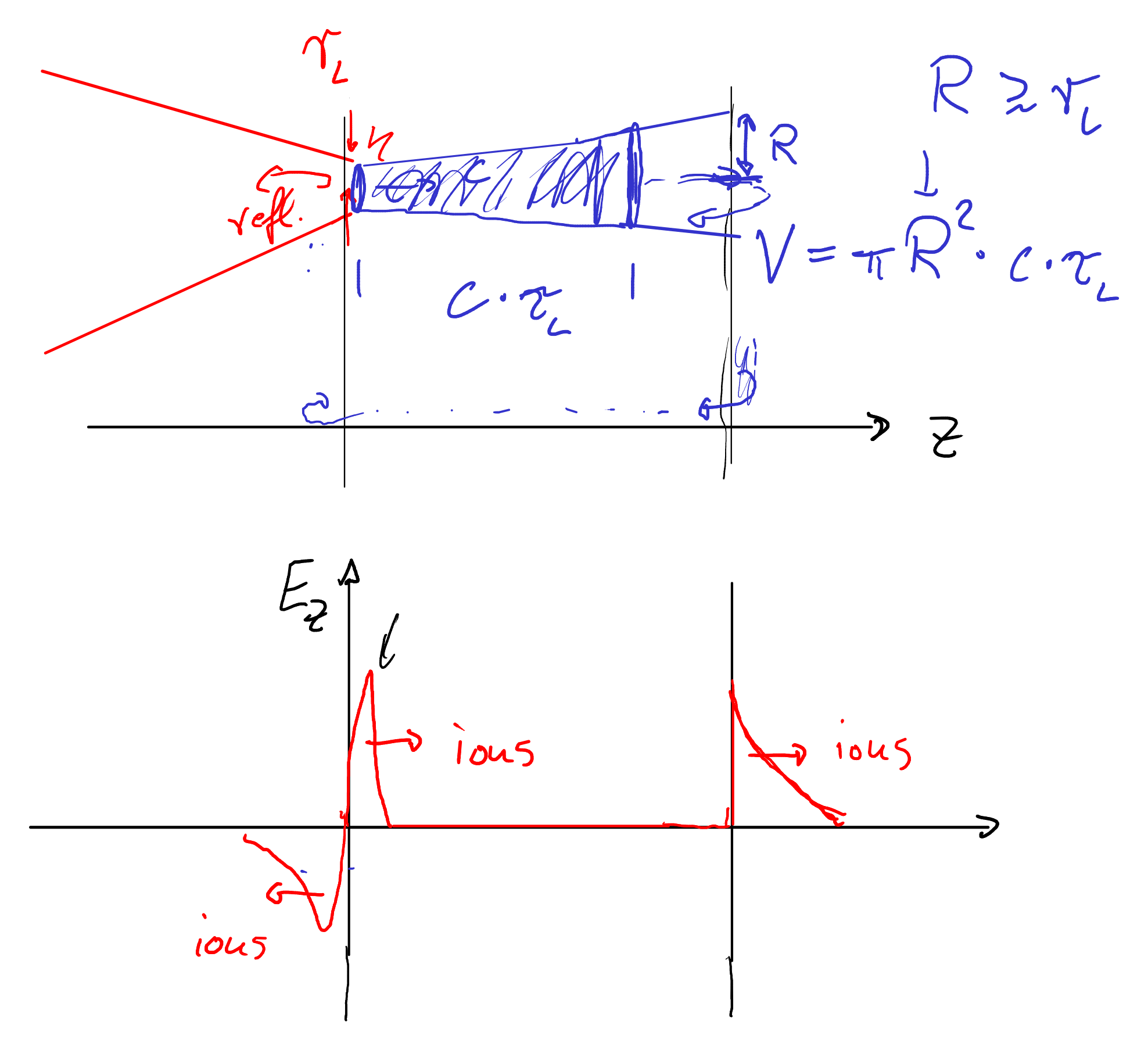
- Exercise 7 reproduces the situation sketched in Figure 7.4 with the 1D3V PIC code.
In Lecture 5 we saw that a free electron in a plane wave cannot retain net energy after the pulse has passed. Yet experiments on overdense targets routinely convert a substantial fraction of laser energy into fast electrons. Today we identify the mechanisms that break the perfect field–motion phase relation — first collisionally, then at the vacuum–plasma boundary without collisions — and connect the resulting electron population to the quasi-static fields that accelerate ions in Lecture 8.
1. Why a free electron does not absorb (cycle average)
For a monochromatic plane wave the electron velocity remains phase-locked to the electric field. The instantaneous power transferred to the particle is \(P(t) = -e\,\mathbf{E}(t)\cdot\mathbf{v}(t)\). Over one optical cycle the positive and negative contributions cancel: \[ \langle P \rangle = \left\langle -e\,\mathbf{E}\cdot\mathbf{v} \right\rangle = 0. \] The same conclusion follows from the plane-wave invariants in Gibbon (Ch. 2) and from your Exercise 4 trajectories: large oscillatory quiver energy, but no secular gain in a symmetric, collisionless field.
Phase breaking is required for absorption. Something must destroy the perfect relation between \(\mathbf{E}\) and \(\mathbf{v}\): collisions, a density gradient, a vacuum–plasma boundary, or relativistic magnetic forces.
2. Collisional absorption — inverse Bremsstrahlung (brief)
Collisions randomize electron momentum and act as an effective friction. A minimal Drude model adds a collision frequency \(\nu\): \[ m\,\dot{\mathbf{v}} = -e\,\mathbf{E}(t) - m\nu\,\mathbf{v}. \] For a harmonic field \(\mathbf{E}(t)=\Re\{\mathbf{E}_0 e^{-i\omega t}\}\) the velocity lags the field: \[ \mathbf{v}(t)=\Re\left\{\frac{-e\,\mathbf{E}_0}{m(\nu-i\omega)}e^{-i\omega t}\right\}. \] The phase lag yields nonzero cycle-averaged absorbed power per electron: \[ \langle P\rangle = \left\langle -e\,\mathbf{E}\cdot\mathbf{v} \right\rangle = \frac{e^2}{2m}\,\frac{\nu}{\omega^2+\nu^2}\,|\mathbf{E}_0|^2. \]
The normalized factor \(f(\nu/\omega)=\frac{\nu/\omega}{1+(\nu/\omega)^2}\) peaks at \(\nu/\omega=1\). In a fully ionized solid at solid density, \(\nu/\omega\) is typically very small for optical frequencies, so collisional absorption alone is often insufficient — but it sets the baseline for underdense plasmas and warm dense matter.
Already covered in detail: the complex dielectric function, Fresnel reflectivity, and collisional absorption plots are developed in Exercise 5, Part C. A standard PIC code without a collision operator does not include this channel unless an explicit scattering step is added.
3. Collisionless absorption at the vacuum–plasma boundary
For overdense solid targets (\(n_e \gg n_c\)) the laser cannot propagate into the bulk; the field penetrates only over the skin depth \(\delta \sim c/\omega_p\). Absorption therefore happens in a thin layer at the vacuum–plasma interface, where the assumptions of a uniform infinite medium break down.
Pre-expansion, ionization, and ponderomotive steepening create a density profile \(n_e(x)\) with scale length \(L = |n_e/\nabla n_e|\). Whether \(L\) is long or short compared to the quiver amplitude \(x_{\mathrm{osc}} \sim a_0\lambda/(2\pi)\) largely determines which collisionless channel dominates:
- Long gradient (\(L \gg x_{\mathrm{osc}}\)): resonance absorption at \(n_e \approx n_c\).
- Sharp interface (\(L \ll x_{\mathrm{osc}}\)): Brunel (vacuum) heating.
- Relativistic intensity (\(a_0 \gtrsim 1\)): \(j\times B\) heating — effective even at normal incidence.
These mechanisms are not mutually exclusive; real pulses at \(a_0 \sim 1\) often involve a mixture. All share the same outcome: electrons gain net kinetic energy that cannot be returned coherently to the field.
4. Resonance absorption
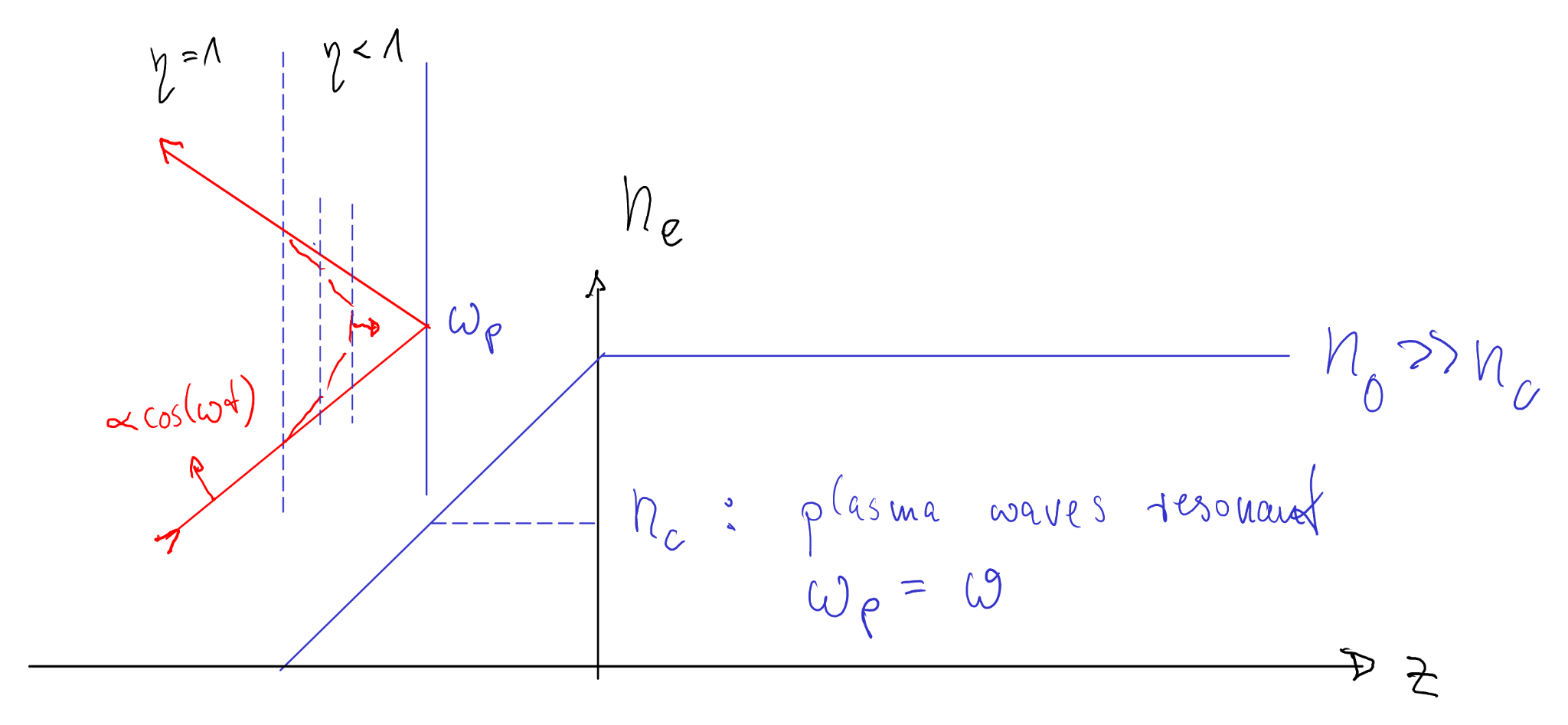
In an inhomogeneous plasma the local refractive index is \(n^2(x)=1-\omega_p^2(x)/\omega^2\). At the critical density (\(\omega_p=\omega\), i.e. \(n_e\approx n_c\)) the index tends to zero and an incoming wave reaches a turning point; beyond it the field is evanescent.
At oblique incidence with p-polarization, the electric field has a component along the density gradient. It can resonantly drive an electron plasma wave (Langmuir wave) at the critical surface. Dissipation of this wave — Landau damping, wave breaking, or mode conversion in a warm or relativistic plasma — transfers energy to electrons. Resonance absorption is favored for sufficiently long density scale lengths and moderate intensities.
5. Brunel / vacuum heating
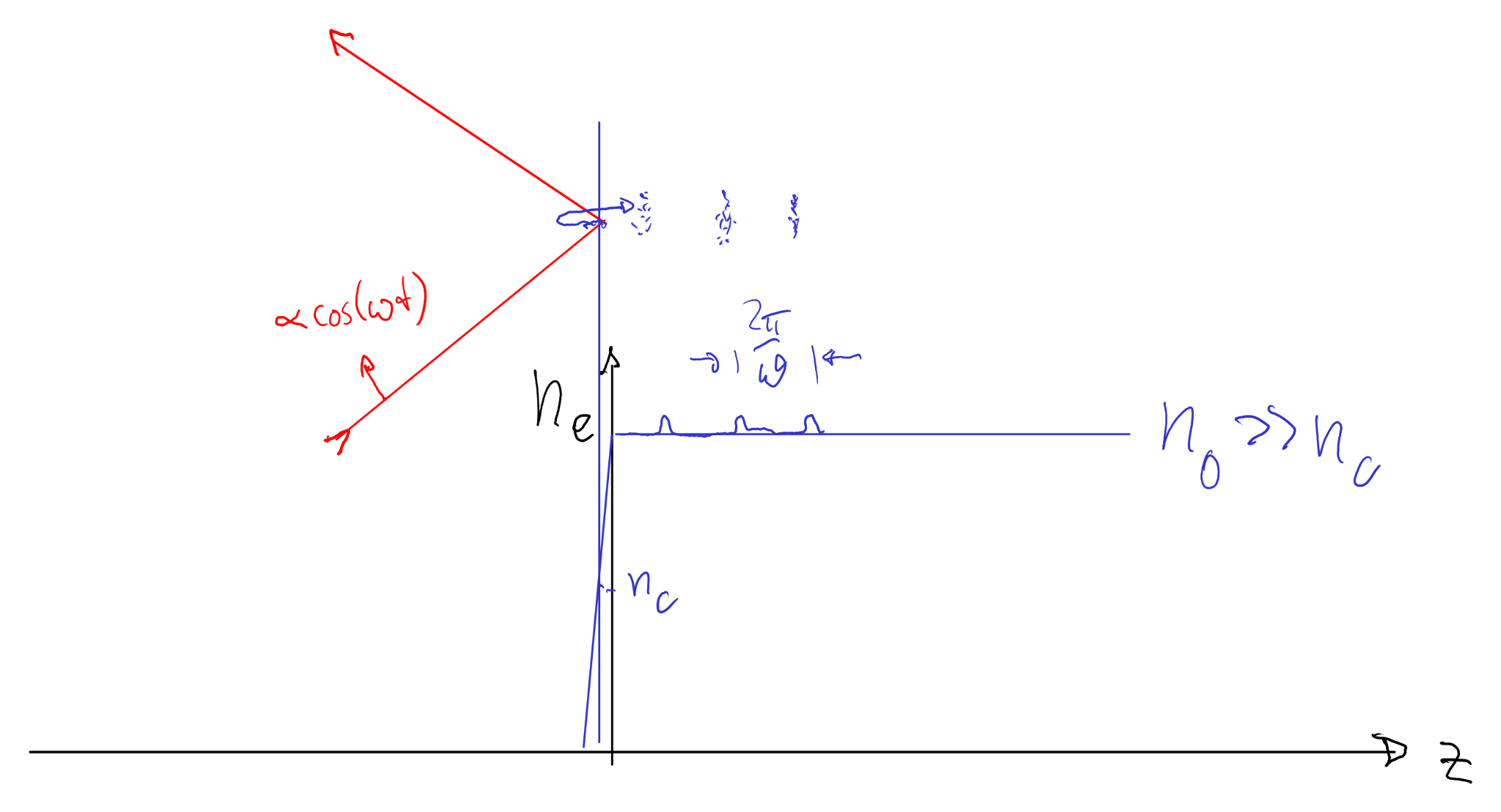
For a very steep density interface the oscillating component of the electric field normal to the surface can pull electrons into vacuum and push them back into the plasma on the next half-cycle. Each reinjection produces an energetic electron bunch — approximately once per optical cycle for oblique p-polarized incidence.
A useful criterion: the interface is “sharp” when the density scale length satisfies \(L \ll x_{\mathrm{osc}}\), with quiver amplitude \(x_{\mathrm{osc}} = v_{\mathrm{osc}}/\omega\) and \(v_{\mathrm{osc}} = eE_0/(m\omega)\) (non-relativistically).
6. Relativistic \(j\times B\) heating
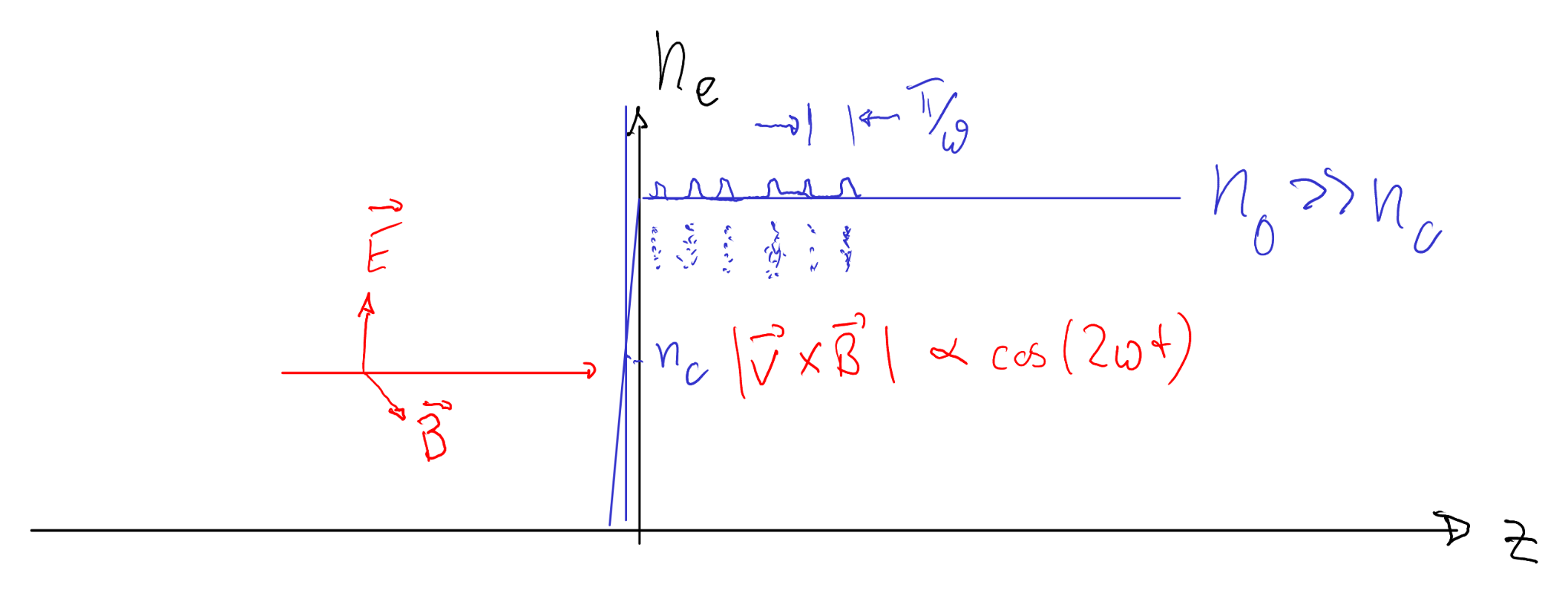
At relativistic intensity (\(a_0 \gtrsim 1\)) the magnetic part of the Lorentz force, \(-e\,\mathbf{v}\times\mathbf{B}\), becomes comparable to the electric force. Even at normal incidence with linear polarization, the \(j\times B\) term generates a longitudinal push on the electrons and produces bunches at twice the laser frequency (\(2\omega\)).
This channel explains strong collisionless absorption observed in PIC simulations and experiments at high \(a_0\), where non-relativistic resonance or Brunel arguments alone would predict little absorption at normal incidence.
Linear vs circular polarization: for linear polarization at normal incidence the \(j\times B\) force oscillates at \(2\omega\) (two pushes per cycle → heating). For circular polarization the magnetic force can be approximately constant in direction over a cycle, pushing electrons steadily into the target without the same \(2\omega\) bunching — often called “no heating” in the sense of no double-frequency modulation, though net pushing still occurs.
7. Bridge to ion acceleration
Whatever the microscopic absorption channel, the macroscopic consequence is the same: a fraction \(\eta\) of the laser pulse energy \(E_L\) is converted into kinetic energy of “hot” electrons. If those electrons have a representative energy \(E_e\), their number is \[ N_h = \frac{\eta E_L}{E_e}. \] The laser focal spot has radius \(r_L\), but the electrons diverge while crossing a foil of thickness \(d\). At the rear surface the electron beam therefore occupies a larger circular area of radius \[ R = r_L + d\,\tan\theta, \] where \(\theta\) is a representative divergence half-angle for transport through the plasma. Produced over the pulse duration \(\tau_L\) and streaming at \(v_e\approx c\), a cycle-averaged hot-electron density at the rear is then of order \[ n_{e,0} \approx \frac{N_h}{\pi R^2\, v_e\,\tau_L} \sim \frac{N_h}{\pi R^2\, c\,\tau_L} = \frac{\eta E_L}{E_e\,\pi R^2\, c\,\tau_L}. \] Equivalently, one may think of the electrons as filling an effective volume \(V\sim\pi R^2 c\tau_L\) — with \(R\) the rear-side electron-beam radius, not the laser focal spot. During the pulse, ions are often effectively immobile on this time scale, while electrons can stream, recirculate through the target, and build up charge separation at the front and rear surfaces.
The resulting quasi-static sheath fields \(E_z\) at the boundaries are the starting point for ion acceleration models. We will develop target-normal sheath acceleration (TNSA) and related schemes in Lecture 8 without re-deriving the absorption microphysics — instead we characterize the hot-electron source (\(\eta\), \(E_e\) or \(T_h\), \(R\) via divergence) and follow its consequences.
8. Outlook
Lecture 8 develops TNSA and related ion-acceleration models, treating the hot-electron population as an input and following the sheath dynamics that expel ions from the target surfaces.
In Exercise 7 you use the 1D3V PIC simulator to reproduce the situation sketched in Figure 7.4: set up an overdense slab, identify absorbed vs reflected energy, watch hot electrons and sheath fields develop during the pulse, and compare post-pulse ion motion with the schematic narrative.