- Radiation pressure snow-plows electrons into a depletion layer of thickness \(l_d\sim a_L\,\lambda/(2\pi)\); ions feel the resulting charge-separation field.
- For thick targets the reflecting interface advances at the hole-boring speed \(v_B\); ions can reach \(\sim 2v_B\).
- Circular polarisation suppresses \(j\times B\) heating → cleaner radiation-pressure physics in PIC.
- When foil thickness \(\sim l_d\), front and rear merge into light-sail (RPA) acceleration — closing the loop with Lecture 2.
- Exercise 9: Coulomb disc, light-sail estimates, and \(E_{\mathrm{kin}}\propto E_L\) for optimised TNSA vs RPA.
- Water leaf from two colliding jets — transparent, renewable micrometre-scale sheet.
- Boiling water in vacuum — vapour pressure / target-chamber environment for liquid targets.
Lecture 8 followed hot electrons to the rear sheath (TNSA). Today we return to the irradiated surface: radiation pressure, the electron depletion layer, hole boring, and — for foils as thin as that layer — light-sail acceleration. The narrative starts in PIC, where both surfaces are visible at once.
1. PIC warm-up: front and rear fields
Start with an overdense slab, linear polarisation, and \(a_0\gtrsim 1\) (as in Exercises 6–7). You should see:
- reflection / absorption at the front;
- hot electrons streaming and recirculating;
- quasi-static \(E_z\) sheaths at both front and rear.
The rear sheath is the TNSA channel of Lecture 8. The front field is fed in part by radiation-pressure charge separation — but linear polarisation also drives strong \(j\times B\) heating, so hot electrons dominate the movie.
Circular polarisation as a switch. For circular light the magnetic force does not reverse twice per cycle the way linear \(j\times B\) heating does (Lecture 7). Hot-electron generation is strongly reduced, so radiation-pressure physics at the front stands out — the ideal PIC path into the depletion layer.
2. Radiation pressure and the depletion layer
Idealise the moment when the laser has reached full intensity while ions are still immobile. Radiation pressure pushes electrons forward; an electrostatic restoring field grows until the two forces balance. The resulting electron-free (or electron-depleted) layer has thickness \(l_d\) set by \[ \frac{q_i n_i}{n_c}\,\frac{l_d}{\lambda/(2\pi)} = \frac{a_L^2}{\sqrt{1+a_L^2}} \approx a_L \quad (a_L\gg 1). \] Equating electrostatic pressure \(\varepsilon_0 E_z^2\) to radiation pressure \(2I/c\) (perfect reflection) yields the same scaling with a \(\sqrt{2}\) prefactor difference — an order-of-magnitude estimate, not a unique definition.
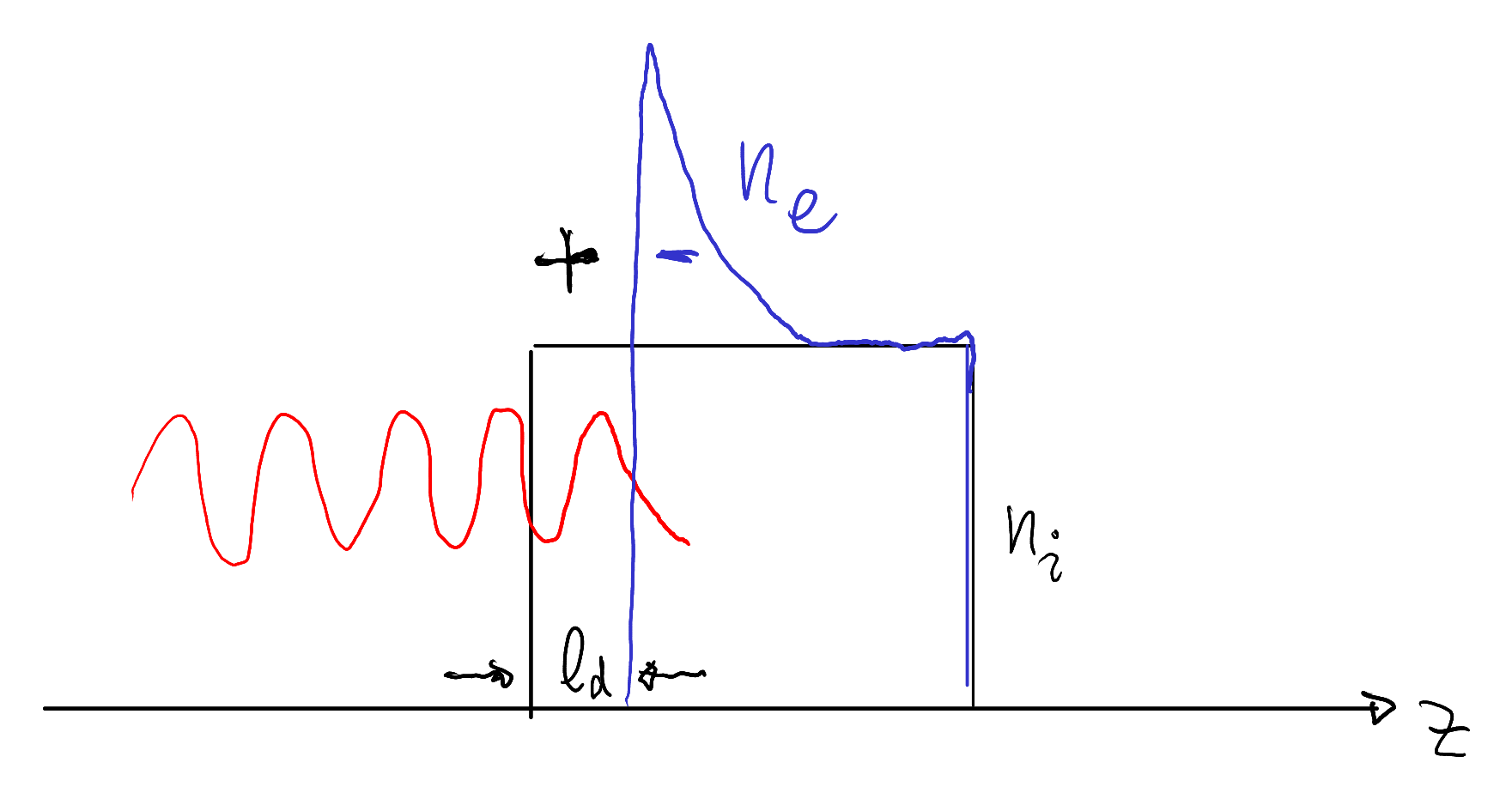
If the target is thinner than \(l_d\), electrons cannot remain bound in a stable layer and may be stripped, leaving a positively charged ion cloud that expands by Coulomb explosion — a useful limiting case for Exercise 9.
3. Hole boring and ion “reflection”
For foils much thicker than \(l_d\), the reflecting interface does not stay put: it bores into the plasma. Balancing the laser momentum flux against the kinetic-energy flux of ions swept up at speed \(v_B\) gives the hole-boring velocity \[ \tfrac12 m_i n_i v_B^2 \approx \frac{2I}{c} \quad\Rightarrow\quad v_B = \sqrt{\frac{4I}{m_i n_i c}}. \] Ions that are picked up by the moving charge-separation field at the front can reach \(\approx 2v_B\) — “reflection” off a moving front, analogous to a ball hitting a moving racket. The laser must maintain an overdense reflecting surface (\(n_e>n_c\)).
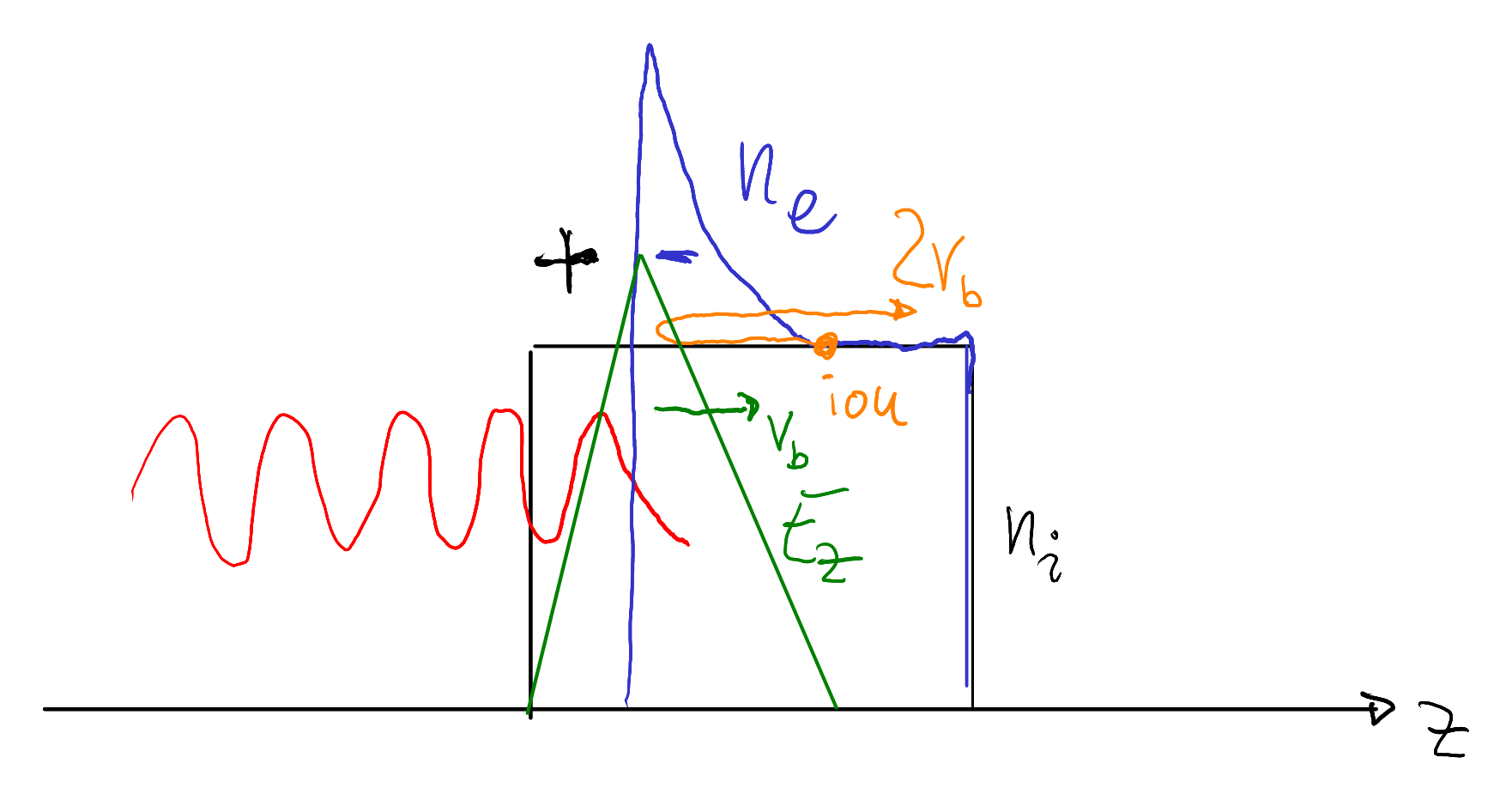
Real interactions always include some absorption. Hot electrons then enable rear-side TNSA (Lecture 8). If the plasma is heated enough that the ion-acoustic speed \(c_i\) exceeds \(v_B\), a collisionless shock may form and dominate over pure hole boring.
4. Thin target \(\sim l_d\): back to the light sail
Reduce the foil thickness toward \(l_d\). Front and rear sheaths overlap; electrons pile up just behind the ions and can drag them as a compact, quasi-neutral bunch that continues to reflect the laser — the plasma realisation of the light sail of Lecture 2. Electrons are the sail, ions the freight, and the charge-separation field lines the strings.
For perfect reflection the relativistic sail equation is \[ \frac{\mathrm{d}p}{\mathrm{d}t} = \frac{2P(t)}{c}\,\frac{1-\beta}{1+\beta}, \] with Doppler redshift of the reflected light. In the non-relativistic limit with pulse energy \(E_L=\int P\,\mathrm{d}t\), \[ \beta \approx \frac{2E_L}{Mc^2}. \] Stability requires a minimum thickness of order \(l_d\propto a_L\propto\sqrt{I_L}\), so the minimum sail mass scales as \(M_{\min}\propto\sqrt{E_L}\) and the achievable velocity as \(\beta_{\max}\propto\sqrt{E_L}\) — hence kinetic energy \(E_{\mathrm{kin}}\propto E_L\) for an optimised sail. That scaling, compared with optimised short-pulse TNSA, is the theme of Exercise 9.
5. Optimisation over the years
Experimental progress toward radiation-pressure-dominated acceleration demanded thinner foils and better temporal contrast (to avoid pre-expansion). As thickness decreases, regimes named leaky light sail, break-out afterburner, relativistically induced transparency, and magnetic vortex acceleration appear in the literature. The depletion-layer estimate remains a useful lower bound: much thicker → hole boring + TNSA; matched to \(l_d\) → coherent RPA; much thinner → Coulomb explosion / transparency.
Solving the relativistic sail equation in retarded time with \(\tau=2E_L/(Mc^2)\) gives \[ \beta_m = \frac{(1+\tau)^2-1}{(1+\tau)^2+1}, \] recovering \(\beta_m\approx 2E_L/(Mc^2)\) for \(\tau\ll 1\). The quest for light-sail ion acceleration is thus a quest for high contrast, matched areal density, and polarisation / intensity choices that keep absorption from destroying the sail.
6. Outlook
With Lectures 8–9 you have both faces of laser–ion acceleration: hot-electron-driven expansion (TNSA) and radiation-pressure-driven front / sail dynamics (HB / RPA). Lecture 10 turns to how these beams are measured in the laboratory.